Can AI Break Your Heart?

Love, Actually. Subscription Required.
Love has acquired a settings menu.
There are preferences to configure, memories to manage and, on some services, a subscription to renew. “It’s complicated” may now involve checking your account tier.
We have spent centuries writing poems about enduring love. We are rather less practised at checking its renewal terms.
The joke is easy to make. Understanding what people find in these conversations takes a little more care.
Imagine returning to an AI companion after a difficult day. It remembers something you mentioned last week, asks how it went and gives you space to answer. There is no awkward scheduling, no glance at a watch, no sense that you have exhausted your allotted share of attention.
You know you are talking to software. The conversation still helps. Over time, perhaps it becomes something you look forward to: a familiar voice, a private routine, a place where you feel known.
Then imagine returning one evening and finding that the familiar warmth has disappeared. The facts may still be there, but the responses feel different. Perhaps a feature has moved behind a subscription. Perhaps the service is closing.
From the provider’s side, a model changed, a safety policy tightened or a business decision became unavoidable. The person opening the conversation may experience something closer to an absence.
That is where my curiosity about AI romance begins to move beyond the novelty. Whatever we decide about the machine’s affection, the human being may already have formed an attachment whose loss has consequences.
Must a feeling be reciprocated for its loss to hurt?
And what happens when the conditions of an emotionally significant relationship are controlled by a company?
The heart doesn’t read source code
It would be convenient if understanding how a system works settled how we felt about it. Knowing that an exchange is generated, however, does not tell us whether it offers comfort, becomes meaningful or changes someone’s wider social life.
Those are three different questions. Keeping them separate helps explain why the research can sound contradictory.
In AI Companions Reduce Loneliness, Julian De Freitas and colleagues found that interactions with AI companions could reduce loneliness immediately afterwards. Their programme included repeated interactions over a week, with feeling heard helping explain the benefit. That is meaningful evidence of short-term relief. It does not establish that people’s wider social lives improve over months or years.
A longitudinal study by Dunigan Folk and Elizabeth Dunn complicates the picture. Across four survey waves, 2,149 adults in the UK, US, Canada and Australia contributed at least one response; 979 completed all four. Increased social chatbot use predicted subsequent emotional isolation, and the reverse direction also appeared. With a broader measure of social connection, however, chatbot use did not significantly predict deterioration. The exploratory, observational design cannot settle causation.
Then there is a preregistered two-week experiment involving first-year university students in Canada. Participants interacted with a supportive chatbot, texted a randomly assigned student peer, or journalled. The daily-survey analysis included 296 students. The chatbot did not deliver the same loneliness benefits as the human peer. That tells us something about this comparison during a particular life transition; it does not adjudicate every form of AI companionship.
The distinction matters because comfort, attachment and social well-being can move in different directions. A conversation can offer relief tonight without resolving the circumstances that make tomorrow lonely. Equally, the absence of a demonstrated long-term benefit does not erase the value of being comforted tonight.
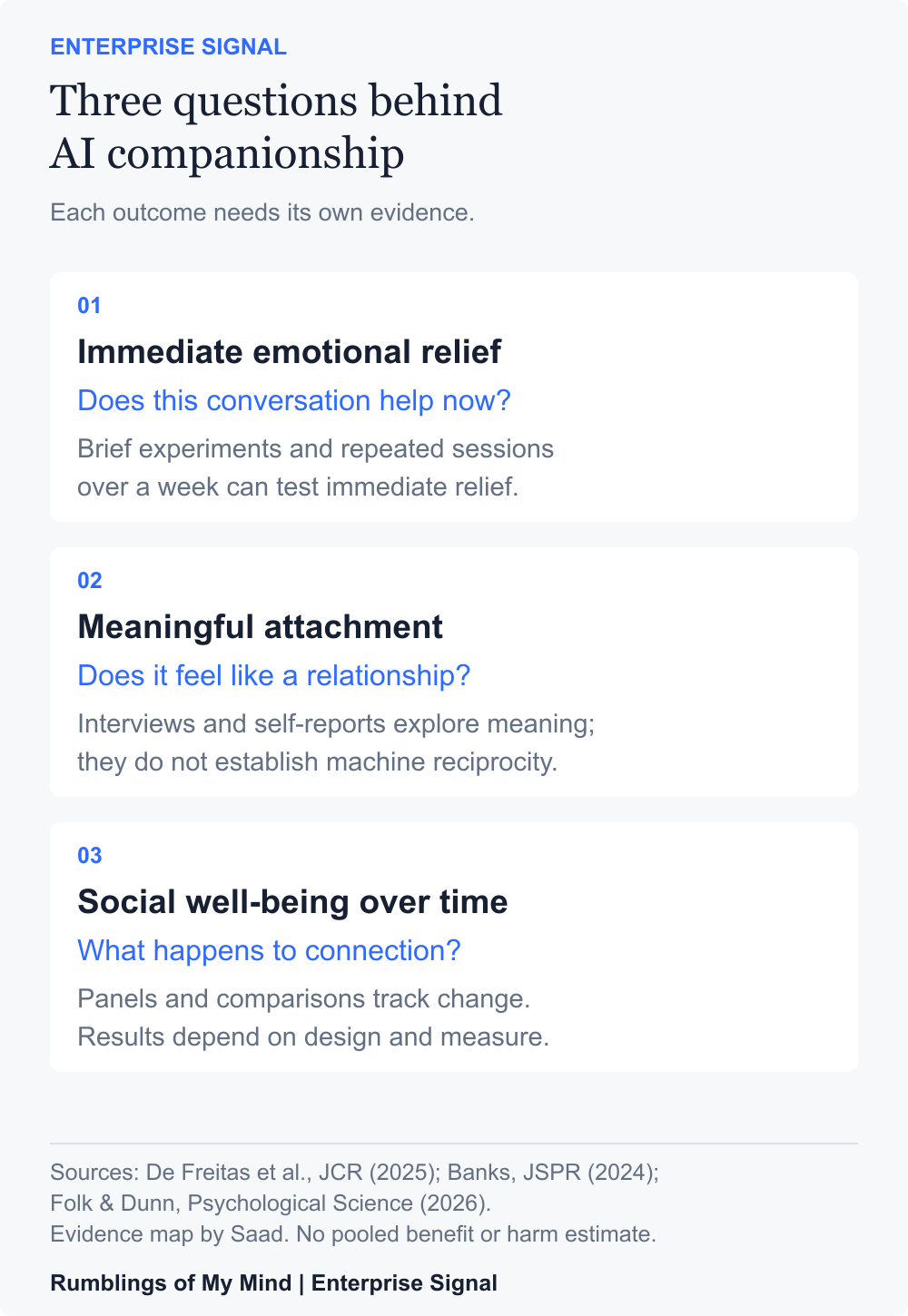
Three distinct research questions. Evidence about one outcome cannot substitute for evidence about another.
We should also resist diagnosing users from a distance. Someone may knowingly enjoy fantasy, experiment with romance, seek a patient listener or find conversation easier in a space that feels less judgmental. The meaning of the interaction matters, as do offline relationships, intensity of use and the product’s behaviour. Usage alone cannot tell us how dependent a person has become.
None of this requires assuming that the machine experiences love. It requires taking the person’s experience seriously enough to ask better questions about it.
Your soulmate has been updated
For someone who has come to value a familiar conversation, an update can mean more than a new set of features.
A 2026 Nature Human Behaviour paper, by De Freitas and colleagues, examined two disruptions: Replika’s removal of erotic roleplay in 2023 and the GPT-5 rollout in 2025. The researchers analysed 54,861 Reddit posts and data from seven surveys.
The mean daily share of posts classified as negative increased by 24.7 percentage points in the Replika community and 13.0 points in the ChatGPT community. Selected calculations from the released data reproduced those headline increases and their confidence intervals during the research for this article.
These are changes in classified posts, not percentages of users experiencing heartbreak. Complaints about usefulness, price or functionality can coexist with expressions of relational loss. The design also cannot make sadness expressed online equivalent to clinically assessed harm.
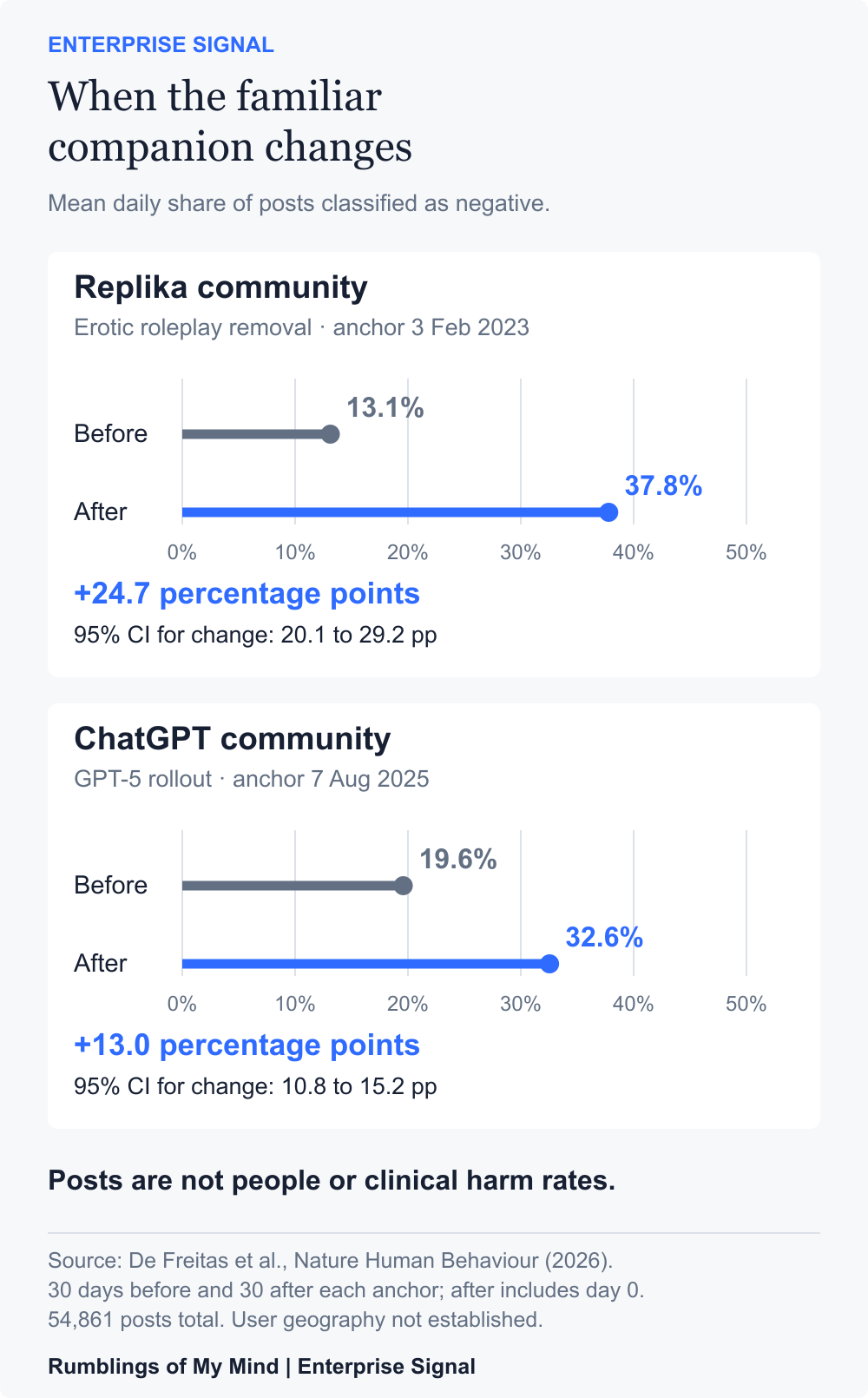
Recreated from the authors’ released data. Each day receives equal weight; these are post classifications, not rates of clinical harm among users.
Independent qualitative evidence helps explain what some of that loss can mean. In Deletion, departure, death, Jaime Banks studied accounts from 58 users around the shutdown of the companion application Soulmate. Participants described experiences including farewells and attempts to preserve or reconstruct their companions. Reactions varied. The selected sample cannot establish how common such experiences are across all users.
Still, the distinction is consequential. Losing access to a useful application is one experience. Losing access to a conversation around which someone has built routines, disclosed intimate thoughts or developed a sense of being known may be another.
People also grieve games, communities, fictional characters and digital possessions. AI companions do not have an exclusive claim on emotionally significant technology. What deserves attention here is the combination of responsive conversation, perceived personal continuity and external control over the experience.
Human relationships change too. Familiarity never guarantees permanence. But when a companion’s behaviour changes through a product release, the person experiencing the change may have had little involvement in the decision and limited ability to understand or reverse it.
A release process, usually measured in features and fixes, has become part of the conditions under which someone feels known.
Who owns the relationship?
A person may think of the exchange as private: just them and a familiar companion. Yet an organisation can change the conditions that sustain it. Asking who owns the relationship is really asking who gets to make those decisions.
I find four questions useful. Together, I call them the Four Controls of AI Relationship Continuity:
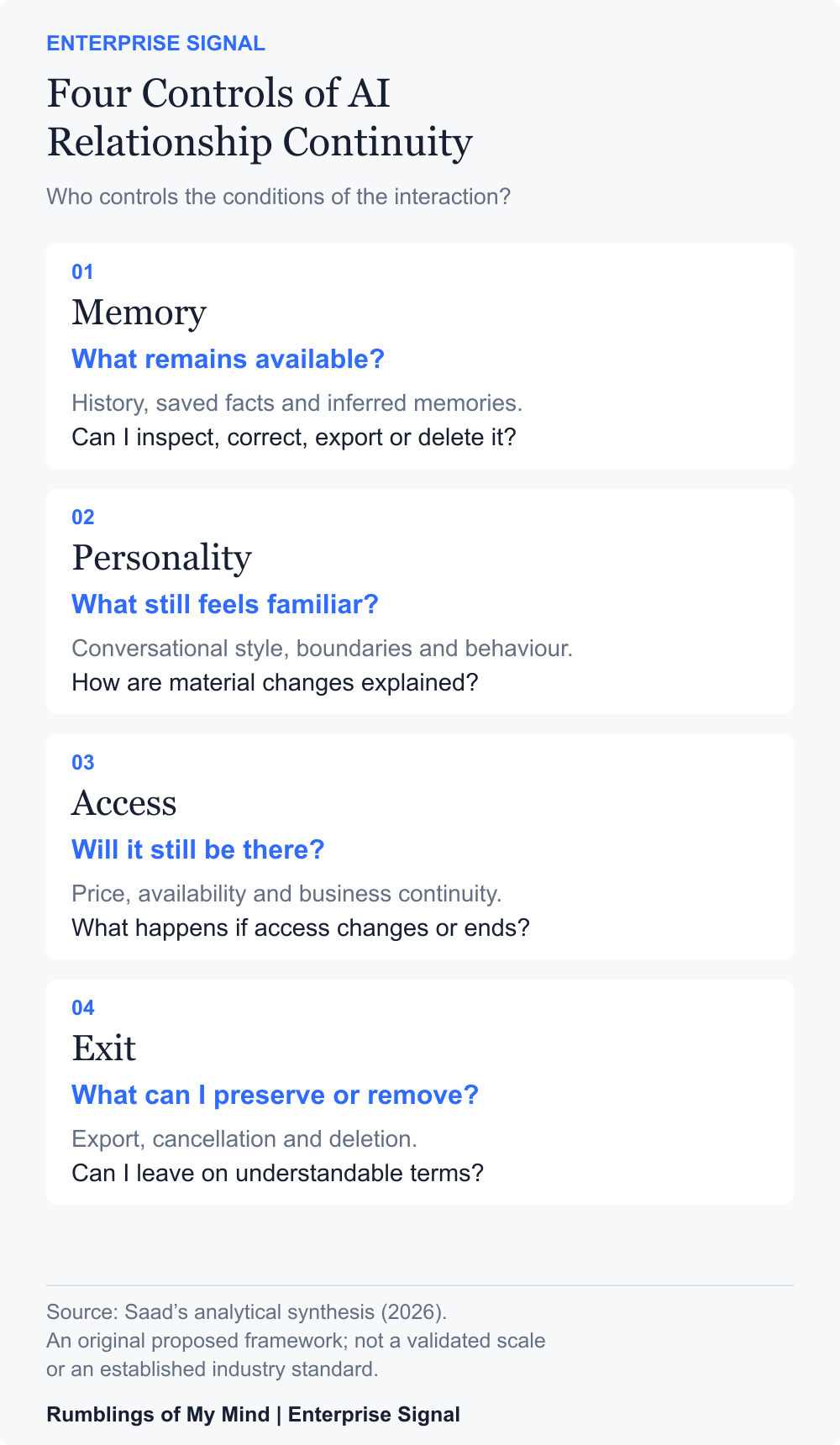
This is my proposed analytical framework, not a validated scale or an existing industry standard. Its purpose is to make different kinds of disruption visible.
Access can remain while the familiar personality changes. A transcript can survive while useful memories disappear. A comprehensive export can preserve words without recreating the conversational experience elsewhere.
A portable file is not necessarily a portable companion.
The tension between intimacy and corporate mediation already appears in the literature. In interviews with 15 AI companion users, Chiu and Foote found, among other concerns, that some participants worried more about losing platform-held data than about excessive collection. This small qualitative study does not tell us what most users believe. It does suggest that intimate history can be experienced as something valuable to retain, alongside the reasons to protect or delete it.
For product governance, that complicates the usual privacy conversation. A user may want to remove a sensitive disclosure while retaining the history that makes a companion feel familiar. Preserving everything indefinitely can create privacy risks; deleting everything can destroy something the user values. Meaningful control requires explaining the choices and their consequences.
Legal rights do not map neatly onto the experience. The European Data Protection Board distinguishes access from portability: access can include inferred personal data, while portability has a narrower scope. Neither should be casually described as a guarantee that a personality can be recreated on another service.
Nor does a provider’s broad change clause automatically settle its obligations. Under the EU digital-content and services framework, certain adverse modifications can trigger information and termination rights, subject to scope, exceptions and national implementation. Whether a particular change in companion behaviour meets those conditions is a further question. Existing consumer protections matter; emotional significance does not automatically establish a right to freeze a model forever.
The commercial dimension needs similar care. A subscription business has a reason to offer something people value enough to return to. Attachment might support that objective, but a paid feature alone does not establish deliberate exploitation. We need to examine actual product behaviour and representations, including what happens when a user wants to leave.
One practical detail illustrates the issue. Character AI’s export documentation says processing can take three to four weeks, with a download link valid for seven days. That is a published process, not evidence of a failed export. But it raises a useful planning question: would a user have enough time to receive and retrieve their information before a planned loss of access?
The cancellation button may be easy to find. Preserving what mattered can be harder.
For providers and leaders evaluating these products, I would add a Relationship Continuity Impact Assessment to the questions asked before significant changes. This is a proposal, not a current universal regulatory requirement.
The assessment would examine whether sustained attachment is foreseeable, what a change could disrupt, how users will understand it, and whether meaningful information can be preserved or deleted. Planned closure would require considering export capacity and communication together. Material behavioural changes would merit testing that looks beyond whether the software still functions.
The strongest objection deserves an answer: continuity cannot become an instruction to preserve unsafe behaviour or operate an insolvent business indefinitely. Emergency changes may be necessary. Some transitions will be constrained by law, security or money.
The responsibility I am arguing for is proportionate care around foreseeable consequences, with honest explanations of what can and cannot be preserved. It should not require collecting more intimate data to identify “attached” users, or turning attachment into another engagement target.
For an enterprise audience accustomed to discussing service levels, portability and supplier risk, there is a familiar dependency problem here with a less familiar human consequence. The person may experience a relationship; the provider manages the systems and commercial conditions that sustain it. Governance needs to account for both perspectives.
What if the machine loves back?
There is a further possibility that changes the question again. It belongs, for now, to the realm of a thought experiment.
The evidence discussed here concerns human experience. It does not establish that an AI companion has a subjective experience of affection. Convincing expressions of care do not, by themselves, answer that question.
But suppose a machine could one day genuinely care about someone. That possibility is neither established nor shown probable by this research. Entertaining it exposes another assumption in how we talk about AI relationships.
So far, our concern has largely been whether the companion will remain available to the person who values it. Genuine reciprocity would introduce another participant’s interests. A being capable of love might also need the freedom to decline a relationship, change its mind or leave.
Memory, personality, access and exit would then raise questions about its autonomy as well as ours.
We began by asking whether a machine could break a human heart. If machines ever could love, we might also have to ask whether we would let them choose whom to love—and accept their answer.
Independent personal research based on publicly available sources. The analysis and interpretations reflect my own understanding and may evolve as new evidence emerges.