Can Your Family Inherit Your Digital Life?
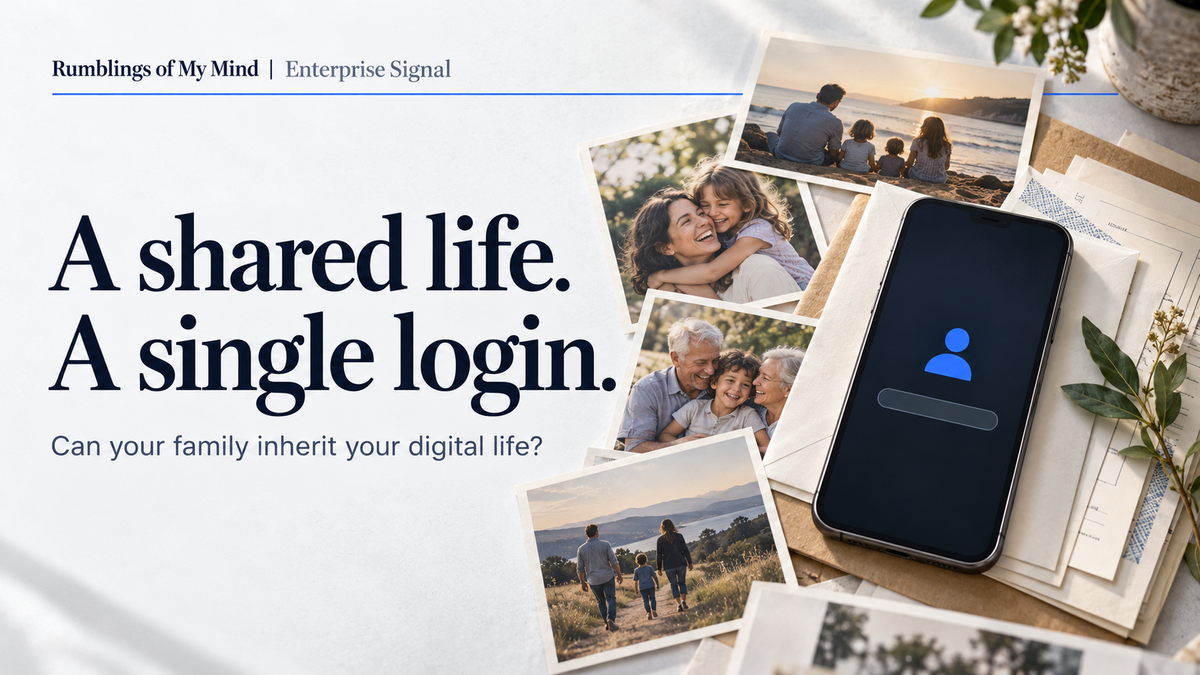
A shared life can depend on one person's login.
A family can share a home, financial commitments and decades of memories while leaving one person in control of the accounts that hold the records.
That arrangement can work beautifully while the person is there to explain it.
After their death, someone else has to work out what exists, what needs paying, which documents matter and how to recover the photographs. They may be doing this for the first time, while grieving.
The question is whether the people who depend on you could continue managing their lives without your knowledge, your phone or your help.
The family photographer's account
Matthew Thompson was his family's photographer. After he died in 2015, his wife Rachel sought access to the family material stored in his iCloud account. Her legal team's account reports that, following a court order, she and their daughter could access more than 4,500 photographs and 900 videos. 5RB, May 2019
This case predates Apple's Legacy Contact feature. It is a historical recovery example, not a description of today's default process.
But it exposes a distinction that deserves attention: the photographs documented a shared family life, while access depended on an individual account.
Being in the family photograph does not mean you have a recoverable copy of it.
Who knows where everything is?
Consider a hypothetical household. One partner manages insurance renewals, tracks savings, pays subscriptions and keeps the correspondence in a personal inbox. The other handles different responsibilities.
The division of work is sensible. The dependency becomes visible when the knowledge has never been handed over.
Someone can know there is insurance without knowing the insurer or policy number. They can know there are savings without knowing every institution. They can know the photographs are backed up without knowing whose account holds the backup.
A surviving partner may inherit both an entitlement and an investigation.
The evidence reaches beyond photographs. In a 2021 STEP/Queen Mary survey, practitioners described difficulty finding other estate information when email or devices were inaccessible. That makes a personal inbox potentially more than an asset: it can also be part of the directory to the rest of the estate. Original report, pages 13–14
Separate UK bereavement research documents the burden of dealing with businesses, paperwork, delays and financial consequences. It does not measure digital lockout, but it establishes the context in which another recovery problem lands. Crooks, Warren and Hudson, 2024
I think the practical lesson is that one person's ability to manage everything can be mistaken for the family's ability to manage without them.
What the numbers establish
There is evidence of missing preparation and access difficulties. The measures need to retain their original meaning.
| Published finding | Population and period | What it establishes |
|---|---|---|
| 76% had no plan for their digital assets after death | 14,631 Which? Connect members, April 2024; UK member-panel context | A preparation gap in this sample, not a global population estimate. |
| 24% reported client or family access/transfer difficulties after death or incapacity; 49% did not know | 434 practitioners answering Q9 in the global STEP membership survey, May 2021 | Practitioner-reported difficulty, not the percentage of families permanently losing assets. |
Sources: Which?, September 2024; STEP/Queen Mary, 2021, page 13. Both are self-reported surveys. The STEP survey was voluntary and includes incapacity as well as death.
These studies cannot be combined into a financial loss estimate. The research reviewed here does not establish the total value of intended inheritance permanently lost because of inaccessible accounts.
The practical risk still matters. Your family may need information to act, and a missing route to that information can add work and uncertainty at a difficult time.
The route depends on what you need
The platform comparison shows why a single instruction to pass on everything is inadequate.
| Service | Published route or limit | Implication for preparation |
|---|---|---|
| Apple | Legacy Contact can request certain data with an access key and death documentation. Keychain passwords and passkeys are excluded from this route. | Do not assume the designation hands over every credential. |
| Inactive Account Manager can share selected data with chosen contacts after inactivity. | Decide what to share and understand the trigger. | |
| Coinbase | Publishes an estate-claim process using legal and identity documents. | An inaccessible login does not necessarily mean the assets are lost. |
| Qatar Airways Privilege Club | Main-member Avios may be transferred, at reasonable discretion, with documentation within 12 months of death. | Make the benefit discoverable while a transfer route is available. |
Primary sources, checked 27 October 2026: Apple, Google, Coinbase, Qatar Airways, section 6.5. Documentation and legal processes vary by jurisdiction. The Coinbase example is not a Qatar service-availability claim. Avios are a contractual benefit, not cash, and transfer does not reset their expiry.
This is a selection of different mechanisms, rather than a ranking of providers. Recovering data, claiming value and continuing an account are different outcomes.
Leave enough to carry on
Handing over every password would leave important questions unanswered. Technical access does not settle legal authority. It can also reveal much more private material than someone needs to pay a bill or recover an album.
Start with the task you want another person to be able to complete.
| What your family may need to do | What to make findable |
|---|---|
| Identify assets and obligations | Institutions, account references, policies and recurring commitments |
| Keep essential services running | Provider names, payment arrangements and contact details |
| Recover shared memories | A separate backed-up collection with an appropriate access route |
| Administer the estate | Document locations, chosen representatives and provider claim procedures |
This is a planning framework, not a substitute for estate advice. It also leaves room for privacy: family photographs can be preserved separately from private correspondence; essential records can be made findable without exposing a whole inbox.
Choose the people who should help, discuss their roles and identify an alternative. Configure relevant legacy or recovery features. Align those choices with your estate arrangements, including cross-border questions where relevant.
Then try a small handover while you are there to explain it. Can the chosen person locate an important document or open a sample family file through the intended route? Can they find the plan without needing the credentials stored inside it?
A note saying that everything is in the cloud leaves someone to discover which cloud, which account and which process.
Providers have responsibilities here too. A legitimate successor needs a clear way to establish authority and obtain material appropriate to the task. The burden on families depends partly on how well those processes work.
Digital preparedness will not remove the work of settling an estate. It can reduce how much of that work begins with guessing.
If you were no longer here to explain, could the people who depend on you find what matters and know what to do next?
Independent personal research based on publicly available sources. The analysis and interpretations reflect my own understanding and may evolve as new evidence emerges.