Rise of the Planet of APIs
We spent decades teaching applications to talk to each other. Now AI agents are learning to tell them what to do.
For much of their existence, APIs have been rather unglamorous.
They moved information between applications, connected systems that were never designed to work together, and occasionally frustrated developers with an impressively unhelpful error message.
They were important, certainly. But rarely the centre of an enterprise strategy conversation.
Then came cloud computing, mobile applications, microservices, digital platforms and increasingly interconnected business ecosystems.
Somewhere along the way, the plumbing became infrastructure.
Today, an enterprise can depend on thousands of interactions between applications, platforms, partners and external services simply to complete ordinary business processes.
And now artificial intelligence is introducing another interesting character into this already crowded ecosystem: the AI agent.
Unlike conventional software following predefined workflows, an AI agent can potentially interpret a goal, select tools, evaluate results and decide what action to take next, within the boundaries established for it.
Suddenly, the humble API finds itself at the intersection of enterprise architecture, artificial intelligence and business decision-making.
Which raises three questions worth investigating.
How significant has the rise of APIs actually been? Are they still relevant in an era of increasingly intelligent software? And could AI fundamentally change their role?
The answers suggest that APIs may be entering their most consequential chapter yet.
Act I: The rise of an invisible empire
APIs did not begin with cloud computing. Software interfaces have existed for decades.
But the modern web API transformed how businesses expose and consume capabilities.
Instead of connecting systems exclusively through bespoke integrations, organisations could increasingly expose functionality through reusable interfaces.
Cloud computing accelerated this approach. Mobile applications made it essential. Microservices expanded its use within applications. Digital platforms extended it across organisational boundaries.
By the middle of the 2010s, API-first development was becoming an increasingly visible architectural philosophy, supported by specifications such as OpenAPI.
The underlying idea was straightforward: design the interface as a reusable contract rather than treat integration as an afterthought.
The evidence suggests that this approach has become increasingly mainstream.
Postman's annual State of the API research reported API-first adoption among respondents at:
- 66% in 2023
- 74% in 2024
- 82% in 2025
The 2025 figure includes organisations reporting some level of API-first adoption, not exclusively those operating entirely API-first.
These are also annual surveys with changing respondent populations. They indicate growing adoption among surveyed practitioners, rather than providing a precise census of all enterprises.
Nevertheless, the direction is notable.
Sources: Postman State of the API 2024 and 2025.
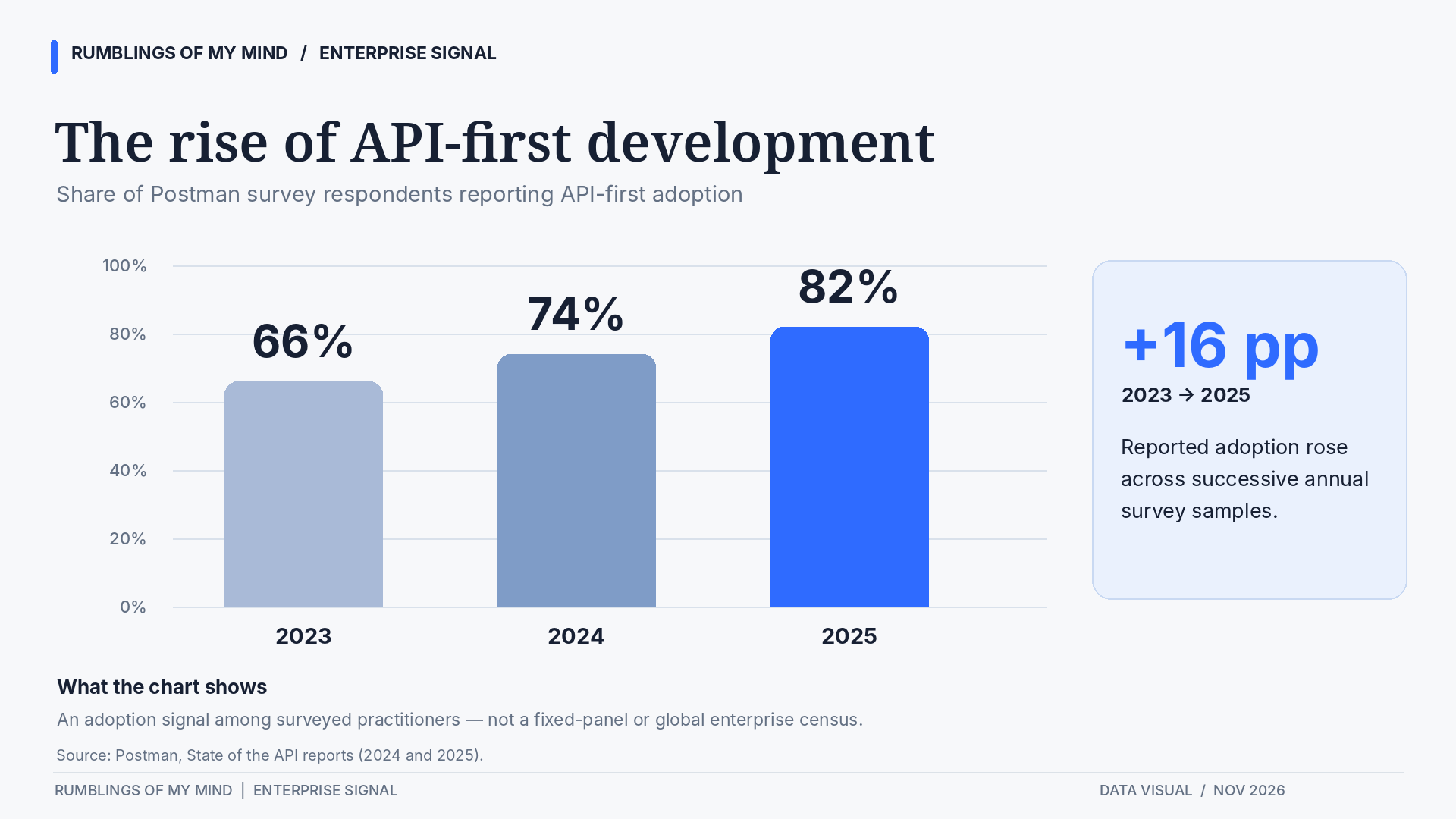
API-first adoption reported by Postman survey respondents: 66% in 2023, 74% in 2024 and 82% in 2025. Annual respondent samples differ; this is not a fixed-panel or global enterprise census. Sources: Postman, State of the API 2024 and 2025.
Network-level evidence offers a different perspective.
Cloudflare's 2024 Application Security Report found that approximately 60% of the dynamic, non-cacheable HTTP traffic observed on its network was API-related.
The finding does not mean APIs account for 60% of all global Internet traffic. Cloudflare measures traffic across its own network and uses a specific definition of API-related requests.
Still, it illustrates the scale at which API communication already operates.
Source: Cloudflare, Application Security Report 2024.
There is an important limitation to all these measurements.
An API request is not the same as an API endpoint. An endpoint is not necessarily a business capability. And an increase in API traffic does not automatically represent an increase in business value.
A single customer transaction might involve dozens of internal API requests because of how the software was designed.
More traffic could mean more business activity.
It could also mean more architectural complexity.
The rise of APIs is real. But counting them may be an increasingly poor way to measure their importance.
Act II: When connectivity became economic infrastructure
Consider what an API actually represents to a business.
At the technical level, it exposes a defined interface through which another system can request information or perform an operation.
At the business level, it may expose something much more valuable.
A payment.
A customer identity.
A credit decision.
An inventory reservation.
A shipment instruction.
An insurance claim.
An employee access request.
The API itself may be small. The business capability behind it might be critical.
Postman's 2025 research found that 65% of surveyed respondents reported their organisations generating revenue from API programs.
Among those reporting API-generated revenue, 74% attributed at least 10% of organisational revenue to APIs.
These findings suggest substantial commercial relevance, but attribution requires caution.
A transaction completed through an API is not necessarily revenue created because of that API.
An airline might sell a ticket through a partner API rather than its own website. The interface enables a distribution channel, but determining incremental revenue requires understanding what would have happened without it.
Similarly, an API that automates invoice reconciliation might create no direct revenue at all while delivering meaningful cost savings.
Source: Postman, State of the API 2025.
This is where API economics becomes interesting.
An API may create value through direct monetisation, faster transactions, reduced operational costs, partner ecosystems or improved customer experiences.
These are distinct value mechanisms. They should not be bundled into a single headline number.
And this is not exclusively a global technology-platform phenomenon.
In May 2024, QNB announced open banking API services for corporate clients in Qatar, enabling direct interaction with banking capabilities, including transaction initiation and information requests.
That development illustrates how APIs can move from a technical integration feature into a mechanism for delivering regulated financial services.
The strategic significance is not how many endpoints a bank exposes.
It is which financial capabilities can be accessed through them, by whom, and under what conditions.
That distinction will become even more important in the AI era.
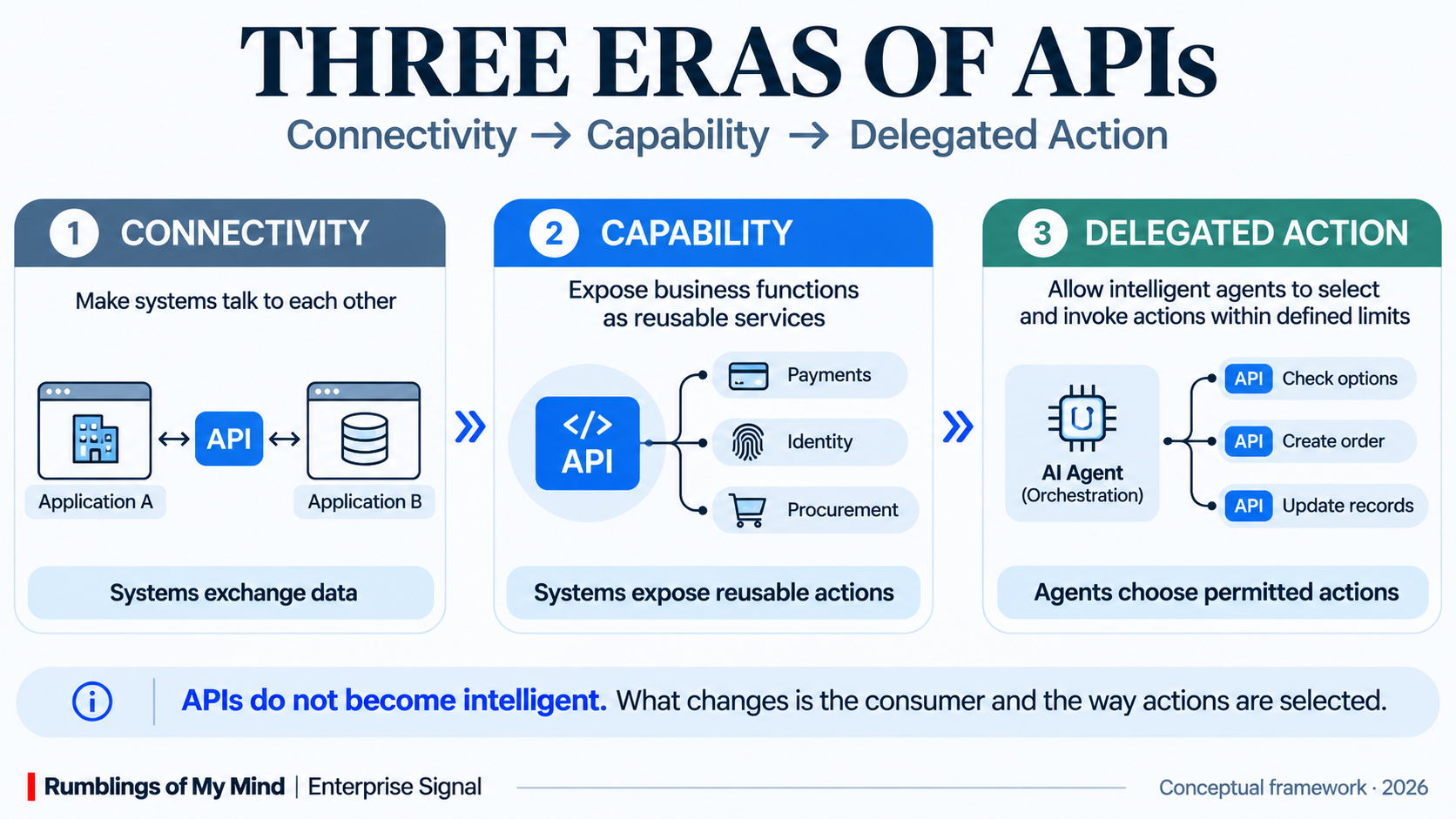
An original analytical framework: the role of APIs expands from connecting applications, to exposing reusable business capabilities, to enabling AI agents to select and invoke permitted actions. These stages overlap rather than replace one another.
Act III: The arrival of a new consumer
Until recently, most enterprise API consumption could be understood through relatively familiar models.
A mobile application retrieves customer information.
An ERP system exchanges data with a logistics platform.
A workflow engine triggers a predefined sequence of activities.
An integration platform synchronises records between applications.
These interactions may be complex, but their execution paths are generally designed or configured in advance.
AI agents introduce another possibility.
An agent may receive a business objective, determine what information it needs, identify available tools, invoke them and adjust subsequent actions based on the responses.
The underlying APIs might remain unchanged.
What changes is the decision-making process surrounding their use.
Postman's newly published 2026 State of the API Report offers an early indication of this transition.
The report, released on 18 November 2026, surveyed 8,953 developers, architects and executives.
Its findings are striking:
- Approximately one in four surveyed organisations report AI agents using APIs in production.
- Only 13.2% report that their APIs are fully ready for AI agents.
- Including those reporting their APIs as mostly ready increases that figure to 36.1%.
The report also found that fully API-first organisations were more likely to report AI agents in production than organisations reporting no API-first adoption: 43.2% versus 16.7%.
That relationship is interesting, although it does not prove causation.
Organisations with stronger engineering practices and greater digital maturity may simply be better positioned to adopt both API-first development and AI agents.
The adoption and readiness figures also describe different survey measures. They cannot be subtracted to calculate the number of organisations running inadequately prepared agents.
Source: Postman, State of the API 2026.
The same research provides a second kind of evidence: actual activity on Postman's platform.
Requests from AI agents to the Postman API through its MCP server reportedly increased 3.3 times between May and October 2026, exceeding two million monthly requests.
That is evidence of growing agent activity within a particular platform, not a measurement of global agent-driven API traffic.
Taken together, however, the findings suggest that AI agents are moving beyond experimentation and becoming operational API consumers.
And that raises a rather uncomfortable architectural question.
What happens when the software consuming an API can decide, within delegated boundaries, which business action to perform next?
Act IV: Will AI eventually make APIs obsolete?
There is a tempting assumption that the more intelligent software becomes, the less it will need traditional interfaces.
After all, if an AI agent can understand a screen, navigate a website and operate an application, why build an API integration?
This is not entirely hypothetical.
Computer-use systems can already perform actions such as clicking, typing, scrolling and interacting with graphical interfaces.
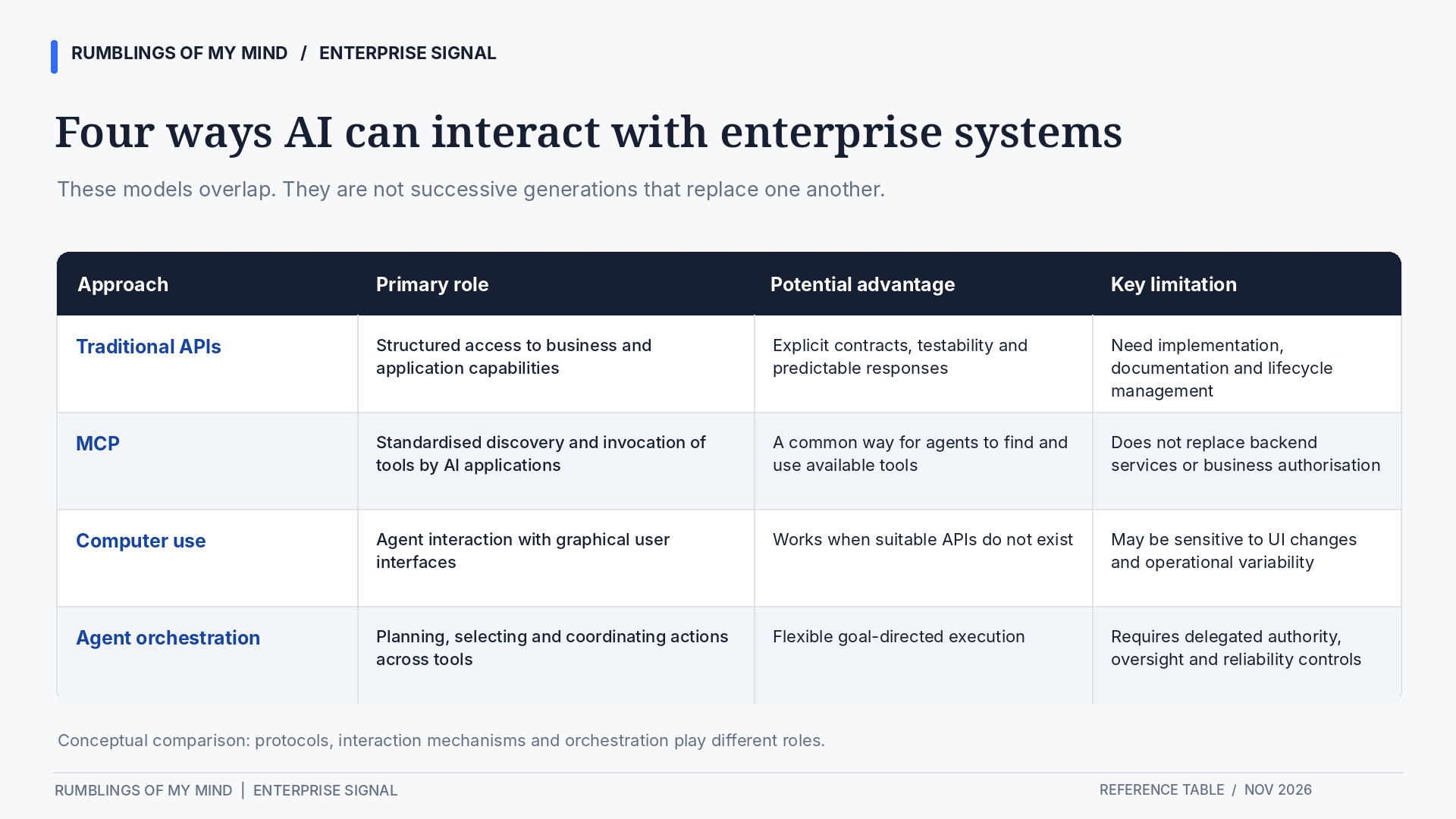
Traditional APIs, MCP, computer-use automation and agent orchestration are complementary mechanisms with different roles, advantages and operational limitations. Original comparison.
For enterprises burdened by legacy applications, this creates an attractive alternative to building specialised integrations.
But there is an important distinction between being able to operate an interface and having a reliable integration mechanism.
Graphical interfaces are designed primarily for human interaction. Layouts change. Elements move. Sessions expire. Errors may be communicated visually rather than through structured responses.
An AI agent may successfully navigate those conditions, but reliability can depend on how consistently it interprets the environment.
A well-designed API, by contrast, can expose a documented contract with explicit request parameters, structured responses, defined permissions and predictable error handling.
That does not make APIs universally superior.
A graphical interface may be the most practical option for a legacy application without a suitable API. And even conventional APIs can be poorly documented, unstable or difficult to govern.
The choice should depend on reliability, implementation cost, operational complexity and the consequences of failure.
There is another development worth understanding: Model Context Protocol, or MCP.
MCP provides a standardised mechanism through which AI applications can discover and invoke tools.
Those tools may interact with APIs, databases or other services.
This creates an additional abstraction between an AI agent and the capabilities it can access.
But MCP should not be confused with a universal replacement for APIs.
It standardises aspects of tool interaction. The underlying business systems still require dependable mechanisms through which their capabilities are exposed and executed.
The MCP specification also includes authorisation mechanisms, but implementing a protocol does not automatically establish appropriate business-level permission for every action an agent might take.
Sources: Model Context Protocol, July 2026 specification and OpenAI, Computer Use documentation.
The most plausible future may therefore be one in which different interaction models coexist.
Traditional applications continue calling APIs.
Automation platforms execute predefined workflows.
AI agents invoke tools through APIs, MCP and other interfaces.
Computer-use systems interact with graphical applications where appropriate.
The interface landscape becomes more varied, while the need to expose reliable business capabilities remains.
In that sense, AI may make APIs less visible to end users without making them less relevant to enterprise operations.
Act V: From connectivity to delegated authority
This is where I believe the research becomes most interesting.
For years, enterprises have focused on making systems interoperable.
Now, as AI agents become capable of selecting and invoking tools, the conversation may need to shift from connectivity towards delegated authority.
Consider a procurement process.
An enterprise might expose APIs that allow authorised systems to retrieve supplier records, verify budgets, create purchase orders and initiate approval workflows.
A conventional automation process would execute those operations according to predefined business rules.
An AI agent could potentially receive an objective such as:
Identify the best available supplier and prepare a purchase order within the approved budget.
It might gather information, compare options and select which permitted tools to call.
Nothing about those individual APIs necessarily changes.
But the process selecting and sequencing their use becomes more flexible.
That flexibility can create efficiency.
It can also introduce new failure modes.
Suppose every individual API call is technically authorised.
The supplier lookup succeeds.
The budget verification succeeds.
The purchase order creation succeeds.
Yet the agent selects a supplier that violates a procurement policy, misunderstands an approval condition or acts on inaccurate information.
Every API may have performed exactly as designed.
The problem is no longer necessarily whether the API worked. It is whether the overall business action should have happened.

Illustrative procurement workflow: even when an AI agent makes technically authorised API calls, business-policy compliance and accountability must be evaluated for the combined outcome. Conceptual example, not a documented incident.
This is not to suggest that conventional automation has never faced such problems. Workflow engines, robotic process automation and integration platforms have long required appropriate business controls.
The potential difference with AI agents lies in their ability to select actions dynamically, introducing additional uncertainty into how an objective is executed.
Postman's 2026 research provides a warning signal, though not a definitive measurement of risk.
It found that 39.7% of surveyed respondents had not addressed credentials and identity for AI agents, while 24.8% reported dedicated agent security controls.
These are self-reported measures. They do not establish that a particular organisation is insecure or that an incident will occur.
They do suggest that organisations are still developing practices for governing this new category of consumer.
Source: Postman, 2026 State of the API findings.
There are also early examples of how the industry is addressing delegated authority.
In March 2026, Stripe described the expansion of its Shared Payment Tokens, which allow authorised AI agents to initiate payments without directly exposing customers' underlying payment credentials.
The mechanisms include tokens scoped to customer intent.
This is an important design direction: the objective is not simply to give an agent technical access, but to constrain the authority exercised through that access.
Source: Stripe, Supporting Additional Payment Methods for Agentic Commerce, March 2026.
And that may prove to be one of the defining architectural challenges of agentic enterprise computing.
Not merely providing access.
Providing appropriate, contextual and accountable authority.
The economics of the next API era
If AI agents become significant consumers of enterprise APIs, the economics of API usage may need to be evaluated differently.
Today, API programs are often assessed through measures such as traffic, availability, response times, adoption, development efficiency and revenue contribution.
These remain useful.
But imagine two ways of completing the same business task.
One uses a conventional integration making five API requests.
The other uses an AI agent making twenty requests, interpreting intermediate results and selecting additional actions.
Which is better?
The answer cannot be determined from request volumes alone.
The agent might complete a complex task that previously required significant human effort. The additional API traffic could be economically justified.
Alternatively, the agent might produce unnecessary requests, higher infrastructure costs, inconsistent results or more exceptions requiring human intervention.
Greater autonomy is not automatically greater efficiency.
A more meaningful unit of measurement may be the successfully completed and appropriately authorised business outcome.
That means examining the full cost of execution: compute resources, API consumption, human intervention, error recovery and the consequences of incorrect actions.
It also means distinguishing between workloads that benefit from dynamic reasoning and those better served by deterministic automation.
Not every workflow needs an AI agent.
Some simply need a better integration.
And occasionally, the most advanced technology decision is recognising that the existing process works perfectly well.
What should enterprise leaders reconsider?
The findings suggest a shift in how enterprises assess their API estates.
An API inventory remains necessary, but may not be sufficient.
Knowing an endpoint exists tells an organisation relatively little about the business authority exposed through it.
A more meaningful architecture assessment would connect three dimensions.
First: Business capability.
Which business processes and consequential actions can be performed through the enterprise's APIs?
Second: Consumers and authority.
Which applications, services, external partners and AI agents can invoke those capabilities? What permissions and constraints govern their actions?
Third: Outcomes and accountability.
How reliably are business objectives completed? Can decisions be reconstructed? Can actions be limited, reversed or escalated when necessary?
These are not exclusively cybersecurity questions.
They involve enterprise architecture, operational resilience, financial control, technology governance and business ownership.
And there is an interesting second-order consequence.
As agent-driven interactions expand, the economic importance of a well-designed API may increase even without significant growth in its traffic share or endpoint count.
A single interface exposing a critical business capability could become more consequential when additional autonomous consumers gain authorised access to it.
Conversely, an enterprise with thousands of APIs may have little to show for that complexity if they expose fragmented capabilities, duplicate functionality or introduce operational friction.
Perhaps API maturity should be measured less by how many interfaces an organisation has created and more by how effectively it exposes, governs and reuses its business capabilities.
The planet of APIs is not disappearing
So, are APIs still relevant in the AI era?
The available evidence strongly suggests they are.
API-first development is well established among surveyed practitioners. APIs support substantial volumes of digital activity. Their business value extends beyond direct monetisation.
Meanwhile, the latest research indicates that AI agents are becoming production consumers of APIs, even as organisational readiness remains uneven.
What the evidence does not yet establish is that AI will inevitably increase the global number of APIs, or that agent-driven architectures will outperform conventional integrations across every business process.
Those remain open questions.
My interpretation is that the more consequential change may lie elsewhere.
The first major era of modern APIs was about connecting systems.
The second made those connections reusable, scalable and commercially valuable.
The emerging AI era may increasingly involve software deciding how and when to invoke those capabilities on behalf of users and organisations.
That does not mean every API becomes intelligent.
It means the intelligence surrounding its invocation may change.
And with that change comes a different set of responsibilities.
We spent decades asking whether our systems could talk to each other.
The next question may be whether we understand what happens when they are authorised to act on each other's instructions.
For a technology that once struggled to get a seat at the executive table, APIs have come a remarkably long way.
The planet is still ours.
But the APIs are acquiring some very interesting new colleagues.
Research notes and limitations
This article draws on publicly available industry surveys, network observations, technical specifications and published product implementations.
Postman's annual surveys are based on changing respondent populations and should not be interpreted as a fixed-panel study of global enterprises. Cloudflare's traffic statistics describe its observed network and defined traffic categories, not the entirety of global Internet activity.
Survey findings about API revenue reflect reported attribution and do not independently establish incremental economic value. Reported associations between API maturity and AI agent adoption do not demonstrate causation.
The architectural and governance implications presented here are interpretations based on the available evidence, not forecasts established with certainty.
Primary references
- Postman — State of the API Report 2026
- Postman — State of the API Report 2025
- Postman — State of the API Report 2024
- Cloudflare — Application Security Report 2024
- QNB — Open Banking API Services, May 2024
- Model Context Protocol — July 2026 Specification
- OpenAI — Computer Use Documentation
- Stripe — Supporting Additional Payment Methods for Agentic Commerce, March 2026
Rumblings of My Mind | Enterprise Signal
Independent personal research based on publicly available sources. The analysis and interpretations reflect my own understanding and may evolve as new evidence emerges.